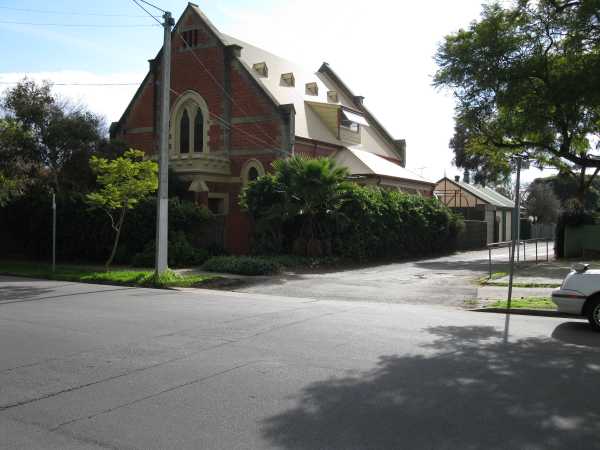
Above was the location of the church hall in Hughes Street, Unley,where The North Unley Boy's Club met.
When I was six, around 1940, a questionnaire was found in our letterbox asking if any boys in the area would like to join a boy's club to be called The North Unley Boy's Club. The questionnaire asked our interests and I know that, among other things, I ticked archery, but it was going to be another 20 years before I picked it up and pulled a bow.
Anyone who returned the form to the address provided received a visit from a gentleman in his mid-40s who introduced himself as a Mr Jessup. Mr Jessup (Pop, as he became known to us) explained to my mother what he was hoping to do in this club. The club was to meet on a Wednesday evening in a Presbyterian church hall in the next street and he hoped that there would be no objection to the evening ending with a short prayer and hymn. We were later to discover this gentleman, George Aubrey Jessup, was the Registrar General of the Adelaide Lands, Deeds and Titles office.
The evening primarily consisted of pretty basic gymnastics using springboard, horse, horizontal and parallel bars and tumbling mats. It wasn't long before the place became known to us as Pop Jessup's gym because that's how we came to think of this kindly, considerate, always proper, gentleman. This man cared about us boys during the worst of the war years and invited us into his life, into his home, and to meet his family.
It was not uncommon to have his two sons, Alan and Len, help out on a Wednesday night to make sure none of us did too much damage to ourselves. His two beautiful daughters, Audrey and Ruth, would occasionally arrive to make our nightly cup of cocoa, to which we contributed the princely sum of one penny.
Some evenings we would go on a moonlight hike which usually consisted of an easy trek up a foothill of the Mount Lofty Ranges, to arrive at a church hall at the top of the hill and a supper of hot pies and pasties.
Occasionally Pop would arrange a weekend hike (either two or three days) through the hills, staying overnight at youth hostels where meals were prepared for us by Alan, Len, or a chap I remember was named Ken Farmer, the people who helped Pop at the gym. And Pop would follow behind in his Wolseley to pick up stragglers.
Come Christmas time, the boys would put on a display of gymnastics, plays and skits to amuse parents. I still remember, over 60 years later, playing the ghost of Marley in the Christmas Carol. "I am the ghost of Marley, your old friend, dead these many years, come, come and look ...". These plays were rehearsed in his beautiful, gracious old home in Palmerston Road, off Young Street where I lived.
A lad joined the club who had lost a leg to cancer (we later, sadly, lost the rest of him) so, to give him some involvement, we started a little lending library of donated books.
For some reason, and I don't know why because the club still existed when I was in my mid 20s, I left the club when I was 16 years old (maybe Pop set an age limit; more likely it conflicted with my trade school attendance). The group of lads around my age who had become friends, continued to congregate together at one home or another, or at a milk bar on Unley Road that, being owned at one time by an English couple, naturally became known as The Pom Shop (even when it was later owned by a young Greek couple). We were soon joined by other local lads, and others from various parts of the metropolitan area, until it was not uncommon for there to be as many as 15 of us. On the rare occasion that we all had girlfriends, that made quite a crowd.
At the time, during the early days of rock and roll, there were concerns for the morality of the youth being influenced by this terrible, so-called music, and the police began watching for gangs of youths hanging around on the streets. As many of us lived in, and around, Young Street, we became known as that 'Young Street Mob'.
Pehaps not how Pop envisaged his boys to look or act 10 years on, but we're still mates. And stil gymnasts.
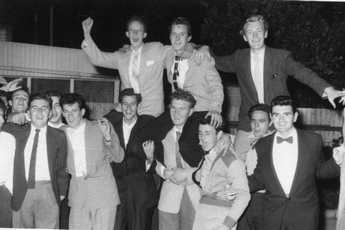
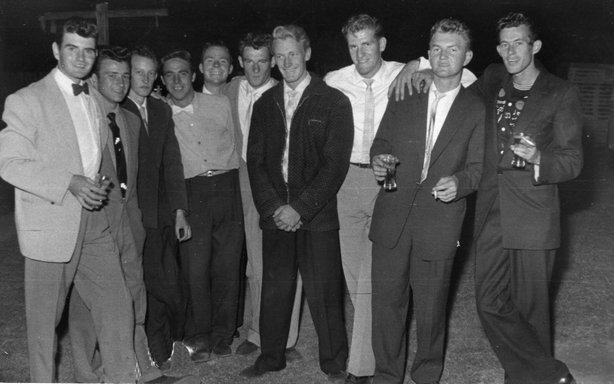
These were the party years: young, single and irresponsible. They lasted for 12 years. It really was a blast.
But the world moved on. The armageddon that rock and roll was going to initiate soon fizzled out, and boys became men. To my knowledge, not one lad who grew up under Pop Jessup's influence, certainly none of my mates from the Young Street Mob, ever came under serious police scrutiny. No matter what I did, I always knew that I would never want Pop to become aware of me doing anything that would cause me to be ashamed of myself.
But it's only as we reached maturity that we realised what an influence Pop had on our lives. He opened our eyes to alternatives and, by example, pointed the direction to what may be called, in old fashioned terms, a more decent way.
Time passes and the church hall no longer exists: in its place are car garages. The Presbyterian church is someone's home surrounded by a high fence. The tree outside the church where Brian and I perched, reading comics purchased from the corner shop ... gone.
The old North Unley Boy's Club (below), now replaced by the cream car gararges at the rear of the converted church/home.
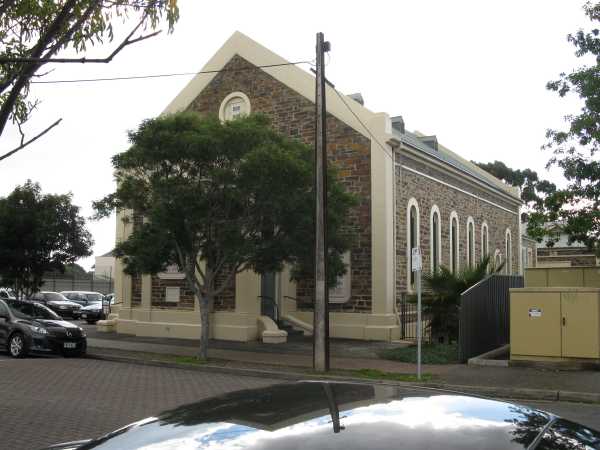
The site of Pop Jessup's beloved Park Street Church of Christ (above), now the Hyde Park Christadelphian Ecclesia.
Sadly, I can't remember the man: I can't remember a word he said; I can't remember what he looked like. But I, and many others, are better people for knowing this gentle man.
But perhaps this is the measure of the man, not to be remembered for what he was, or what he looked like, but by the quiet example he set. What he did without saying that this is the way to do it. How he treated people without insisting that we do likewise. The way he spoke without saying 'do as I do'. To be a Christian in the true meaning of the word without the religious hypocrisy that could have been pushed into our young minds.
But, still, I wish I could remember what he looked like.
And, searching the internet, this wonderful man is only remembered by the 10 books or articles he wrote on land titles in South Australia, in the memoirs of the ministries of Reverend Harold Norris who remembers Pop as 'the leader of a young men's bible class of mostly university students' at the Park Street Church of Christ, now a church of a different denomination, and in pieces of family tree data on various genealogy pages.
The information distributed via that family tree, if accurate, indicated that Len married and had two daughters, Alan and his wife had a son, and Audrey and her husband had two sons and a daughter. Those children would have grown up and probably had children of their own. It would be so sad if they all grew up not knowing how much respect and affection a group of lads from very ordinary backgrounds had for their father, grandfather, and great grandfather, what he did for them at The North Unley Boy's Club, and how knowing Pop Jessup may have influenced their lives.
Around 1990. All but one are Pop's boys, and all but one is still kicking on in 2010.
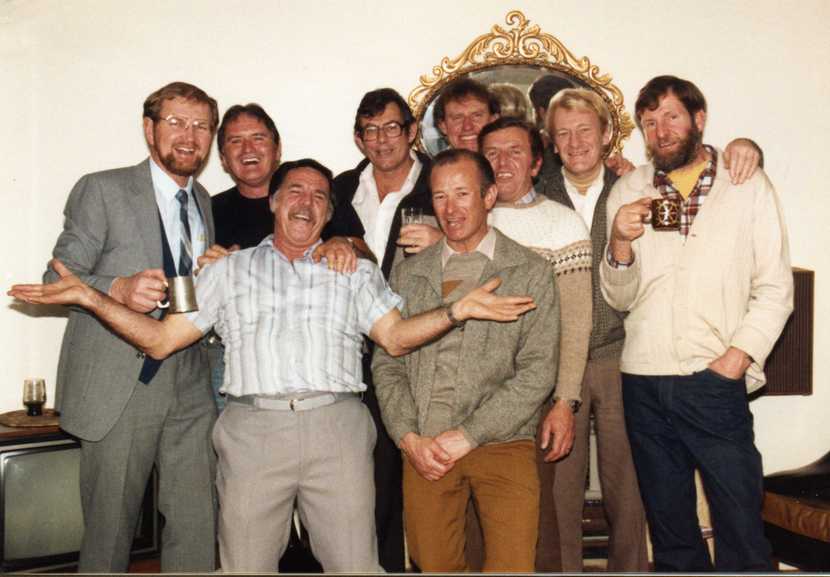
But, he is still remembered by this group of aged men who were the original members of The North Unley Boy's Club, who later became The Young Street Mob, then successful in their chosen careers, who remained friends to become life-long mates for nearly 70 years.
Because they met at the North Unley Boy's Club and grew up having known Pop Jessup.
And amongst the pearls of wisdom received via internet mail, it's perhaps appropriate that today as I write this, I received the words below.
It's not what you gather but what you scatter that tells what kind of life you have lived.
In the large order of things, George Aubrey Jessup's initiating a boy's club in the 1940s is perhaps, (perhaps?), not worthy of note, but to a group of lads, many from broken homes, some with fathers in the armed services, Wednesday evening at Pop Jessup's gym was something to which we looked forward. Its influence is still felt today. In that club, on those hikes, rehearsing those plays, supporting each other in that gymnasium, we got to know each other as only children know each other. We learnt how to become friends and we learnt how to stay friends. We grew up never feeling alone; knowing that whatever problems we may face, we could call on mates for support.
And we had some times.